|
You are only seeing a fraction of my work. If you want to see it all join my Patreon page at https://www.patreon.com/itsmetoo If you are already a supporter, go to the Table Of Contents on my Patreon and click the proper link to get the new password. |
Captioned Images Series: Last Wish
Created: 02/28/2026
James Manza was only twenty-five when the doctors told him there was nothing more they could do.
The disease had worked quietly at first, stealing strength from his broad shoulders and heavy arms. Once a large, solid man who filled a doorway, he had withered into angles and hollows. Muscle melted from bone. His voice grew softer as his body thinned. In the mirror, though, something unexpected began to emerge.
As the weight fell away, James sometimes studied his reflection for long stretches. The hard lines he had always resented softened. His jaw looked less square. His eyes, always expressive, seemed larger in a narrower face. Beneath the loss and the pain, he saw her—the woman he had imagined since he was a teenager, the woman he had never allowed himself to become.
There had always been reasons.
He believed he would never “pass.”
He didn’t want to upset his parents, who loved him fiercely.
And the cost—financial, emotional, social—had always seemed impossible.
So he buried it. He built a life around being James. And then time, cruel and unmovable, began to run out.
When a charitable foundation that granted final wishes to adults approached him, they expected something typical—a trip somewhere beautiful, a reunion, perhaps an experience he had missed. Instead, James surprised them.
“I want to die as her,” he said quietly. “As the woman I should have been.”
From that moment forward, barriers fell. Paperwork was expedited. Specialists were assembled. No expense was spared, not because the foundation saw spectacle in his wish, but because they saw urgency—and authenticity.
Hormone therapy began immediately, delivered gently and steadily. Surgeons performed procedures that James had once believed were fantasies reserved for wealthier, braver people. His body, already slender from illness, responded quickly. His features were refined with careful cosmetic work. Breasts were sculpted to suit his frame. His hips were shaped to create a graceful silhouette. Subtle changes to his lips and brow softened the remnants of the old mask he had worn.
Recovery was painful at times. His strength was limited. But through it all, he smiled more than the nurses had ever seen.
When a stylist placed a honey-blonde wig—wavy and shoulder-length—on his head for the first time, he wept. Not from grief. From recognition.
“My name is Brooke,” he whispered.
Brooke Collins.
The name felt like air after years underwater.
As the end approached, the foundation arranged something Brooke had never dared imagine: a professional photo shoot. A real one—lights, cameras, a team treating her not as a curiosity, but as a woman preparing for her moment.
Makeup artists softened the shadows of illness. Contour and blush brought warmth to her cheeks. False lashes framed bright, tearful eyes. Every imperfection was blended gently away, not to erase her story, but to let her see herself without the imprint of suffering.
She wore several outfits that day—flowing dresses, elegant blouses, tailored skirts—but one ensemble became her favorite.
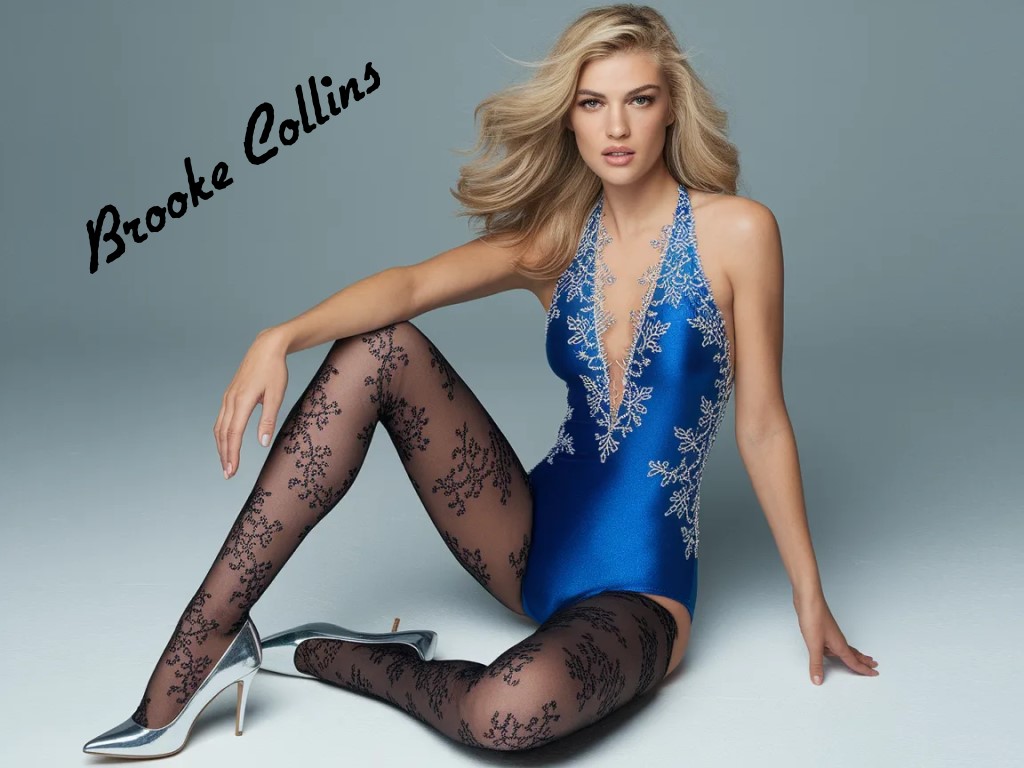
It was a form-fitting, one-piece halter swimsuit crafted from shimmering sapphire blue fabric. Delicate silver embroidery traced intricate floral patterns along the neckline and down the sides, catching the light with every movement. She paired it with sheer black lace tights patterned with swirling vines and blossoms. On her feet were metallic silver stiletto heels—sleek, unapologetic, glamorous.
In that outfit, propped carefully and supported when needed, Brooke looked radiant. Not because she was perfect. Not because the illness had vanished.
But because the person inside her had finally stepped forward.
The photographer captured dozens of images. In them, Brooke smiles softly. In some, she laughs. In one—her favorite—she stands tall despite the IV port still hidden beneath makeup and fabric, chin lifted, eyes steady. She looks like a woman who has claimed herself at last.
She did not have long after that.
In her final days, friends and family came to see her. Some struggled. Some cried. But most, seeing the peace on her face, understood in ways they hadn’t before. They began calling her Brooke. Her mother held her hand and whispered, “You look beautiful.”
When she passed, it was quiet.
She was buried according to her wishes. The name etched into the stone read:
Brooke Collins
Beloved Daughter
Finally Herself
At the small service, a framed photograph from the shoot stood beside the casket—the one in sapphire blue. No one spoke about the cost, the logistics, or the impossibility of it all. They spoke about courage. About authenticity. About how even at the edge of life, it is never too late to become who you are.
And somewhere between grief and grace, they understood that James had not disappeared.
He had simply, at last, become Brooke.
Made with Ideogram Generator